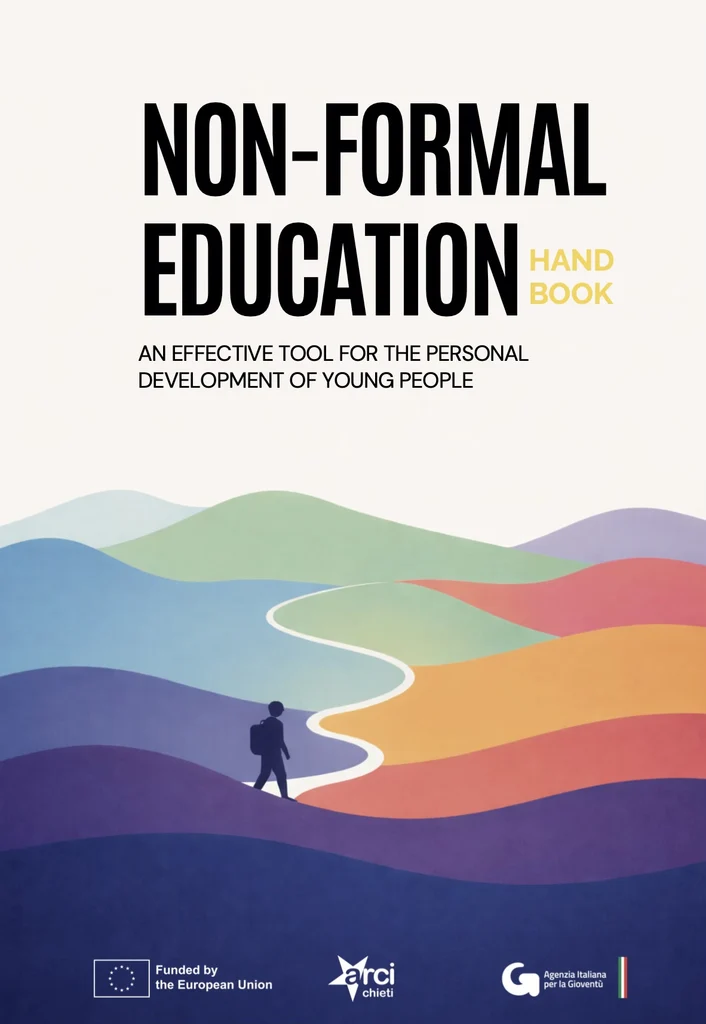
Learning does not happen only in classrooms. It also happens through play, dialogue, cooperation, direct experience, community work and the simple act of doing things together. This was the starting point of the Erasmus+ Youth Seminar Non-Formal Education: An Effective Tool for the Personal Development of Young People, held in Chieti, Italy, from 24 to 30 November 2025.
The seminar was organised by ARCI Circolo Territoriale Chieti APS and supported by the Erasmus+ Youth Programme and the Agenzia Italiana per la Gioventù. It involved 24 youth workers, youth leaders, educators, teachers and volunteers from Belgium, Bulgaria, Denmark, Germany, Italy, Romania, Serbia, Slovakia and Spain. The partnership brought together organisations and educational realities active in youth work, social inclusion, environmental education, outdoor learning, intercultural dialogue and community engagement, including ARCI Circolo Territoriale Chieti APS, EiBo!, MUNDU, Natural Explorers, Roter Baum Berlin, the Elementary School of Veľké Leváre, BROZ, Remonta, Asociación El Nexo, Agenda 21, Foresteducon, MJ Les Récollets.
The project was created as the beginning of a wider path of cooperation on the use of Non-Formal Education in different European contexts. Its main aim was to explore how non-formal methods can support the personal development of young people, especially those coming from disadvantaged backgrounds. Participants worked together to share approaches, techniques and methods that could be adapted and reused in their own local communities. The seminar focused on themes such as intercultural education, communication & critical thinking, outdoor education, environmental education, active citizenship, food and nutritional education, and community development.
A central part of the work was the exchange of good practices. Partner organisations presented projects and activities developed in their local contexts, showing how Non-Formal Education can be used in very different fields. These examples included social inclusion projects with people experiencing mental health difficulties, environmental education about wolves and biodiversity, mobile youth centres, public art and human rights initiatives, outdoor learning, school parliaments, intergenerational activities, food education, community cafés, inclusive sport and youth participation projects.
Starting from these experiences, participants developed a shared methodological platform. This platform brings together principles, reflections and practical tools around five key areas: Active Citizenship, Environmental Education, Intercultural Education, Outdoor Education, and Food and Nutritional Education. Each section explores what the topic means, why it matters, which challenges it addresses, which methods can be used and what impact it can generate.
The final publication collects the results of this common work. It is both a record of the seminar and a practical resource for teachers, youth workers, volunteers, youth organisations and public bodies interested in bringing non-formal methods into schools, youth centres, communities and public institutions.
You are invited to download the booklet and explore the practices, ideas and tools developed during this shared European learning process.